
I like to think about myself as a productive particular person. I’ve been writing for over a decade and now know how one can plan my time properly. Nevertheless, right here’s the factor — stress! It’s been my nemesis for the final two years, if no more. Decided to enhance my high quality of life, I began going to remedy periods. Properly, I didn’t need to reside on antidepressants eternally. So now I intention for much less stress. However let’s face it — work can pile up and trigger chaos.
Once I stumbled throughout David Allen’s “Getting issues finished,” it felt just like the universe was nudging me to select it up. The promise of stress-free productiveness referred to as out to me. Why not give it a shot?
Why learn the e-book? How does it differ from different productiveness bestsellers?
Many individuals choose up productiveness books hoping to learn to turn into tremendous environment friendly, how one can sort out limitless to-do lists and turn into that “ideally suited” success story. However usually, the books go away you feeling burned out, even while you’re checking off every little thing on the record. They present you how one can do extra. What they didn’t do, although, is be sure you really feel fulfilled.
What units “Getting issues finished” aside? For me, this e-book isn’t just about knocking out duties; it’s about protecting a transparent and calm thoughts so that you keep away from the stress of looming deadlines and misplaced alternatives. This writer guides you to attain your targets whereas sustaining your peace of thoughts.
The GTD technique at a look
What’s GTD? David Allen’s GTD technique revolves round 5 core steps designed that can assist you remodel the way you handle duties:

Getting issues finished abstract in 3 minutes
You’ve most likely come throughout alternative ways to spice up your private effectivity. So did I. In order for you extra reads, try my summaries of:
Now, I’m all into GTB. Earlier than I realized about it, I believed GTD was simply one other job administration system. It really stands for “Getting issues finished,” a way created by David Allen. So, is it any higher in comparison with different “productiveness improve” strategies? Let’s discover out.
GTD, or Getting issues finished, helps you collect and set up data so you will discover what you want simply. It’s like placing your packed backpack by the door the evening earlier than. This manner, you received’t neglect it if you find yourself in a rush the subsequent morning.
All of us have unfinished duties bouncing round in our heads, which may waste quite a lot of time and power. The answer? Write them down and make a plan.
What actually stunned me about GTD is that there are not any detailed to-do lists for initiatives. No “elephants” or “frogs” that you must sort out every day. There’s no give attention to significance both. As a substitute, duties are sorted by context, like:
-
Issues you must do whereas on the street
-
Issues you must do at a gathering together with your boss
-
Issues you must do in your pc
-
Issues you must do at residence.
This manner, you possibly can focus on what you possibly can really get finished in no matter state of affairs you end up in.
What about priorities? As I discussed earlier, there are not any strict priorities, so how do you establish what’s most essential? The reply is straightforward: depend on your logic and instinct. Because it’s inconceivable to foretell each state of affairs and priorities can shift all through the day, why spend time attempting to outline them? For me, this implies much less stress.
Key steps to take motion
If you happen to’re able to apply the GTD technique, attempt to undertake these instruments:
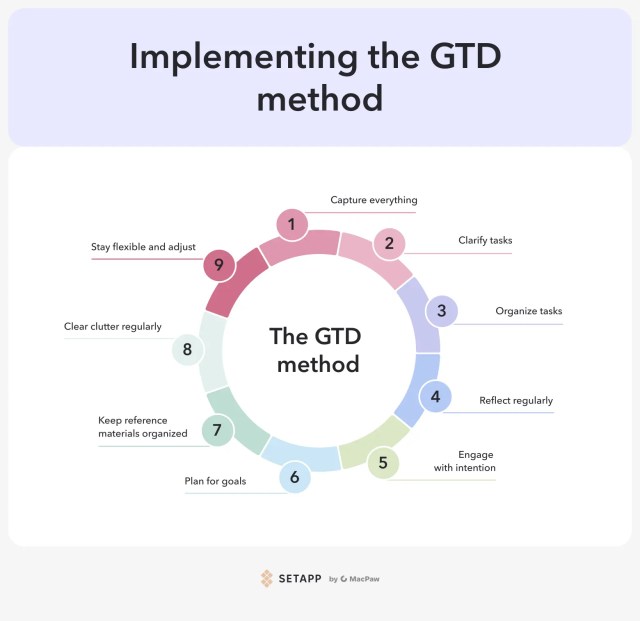
1. Seize every little thing
Initially, get every little thing in your thoughts out of your head. Significantly. Write down duties, ideas, and concepts as they arrive to you. This frees up psychological area, and you’ll give attention to what’s essential later.
Steps to take: Maintain a pocket book or use an app to jot down every little thing that wants your consideration.
TaskPaper lets you simply jot down your ideas in a distraction-free setting and set up them into lists with tags and initiatives.

2. Make clear your duties
When you’ve captured every little thing, it’s time to determine what every merchandise means. Decide what must be finished subsequent for every job or if it’s simply one thing to maintain for later.
Steps to take: Have a look at every merchandise and ask your self: What’s my subsequent step? If it’s a job, resolve while you’ll sort out it. If it’s simply data, know the place to search out it later.
3. Arrange your duties
The following step is to place your duties into classes that make sense for you. This may very well be by venture, urgency, sort of labor, or no matter you want. Having every little thing sorted helps you already know what to sort out subsequent. If you happen to work with individuals, you’ll moreover want a “Pending” record. It should include every little thing that requires dialogue and settlement. Fascinating and surprising concepts additionally have to have their very own place. Create a “Sometime/Perhaps” record.
Steps to take: Be sure it’s simple to see what’s in your plate. Use labels or folders in an app like GoodTask to maintain your duties organized. This app works rather well with Apple Reminders and Calendar. You may rapidly create duties with simple actions, templates, and textual content shortcuts. Plus, you have got the choice so as to add subtasks and attachments, and you’ll hold every little thing organized utilizing tags.

4. Mirror recurrently
Take time every week to overview your duties and plans. This may hold you on monitor and enable you regulate as wanted. Though it could appear redundant, reflection nonetheless lets you have fun progress and spot potential roadblocks.
Steps to take: Put aside a selected time every week to overview your record. Ask your self what’s working, what’s not, and what wants to alter. Then, attempt to formulate the subsequent motion and date.
5. Interact with intention
Resolve what duties to give attention to based mostly on what’s essential, how a lot time you have got, and your power stage. This manner, you may be certain you’re engaged on the correct issues on the proper time.
Steps to take: Earlier than you dive into work, rapidly assess what you are feeling able to sort out. Use an app to remain centered throughout your work periods. Be Centered is an excellent easy to-do software that comes with a Pomodoro timer that can assist you not get sidetracked. Simply add a job, kick off a 25-minute timer, knock it out, and deal with your self to a break afterward.
You may hold tabs in your progress and see how a lot time you’ve spent on every job. Plus, Be Centered can block distracting apps, making it simpler so that you can keep centered in your work.

6. Plan in your targets
This can be probably the most essential elements for me. Now, you must put your long-term targets into actionable steps. This manner, you’ll know what path to maneuver in and when you’re making any progress day-after-day.
Steps to take: Break down your high targets into smaller duties. You may create a thoughts map utilizing MindNode. This software helps you set up your concepts visually, which makes it simpler to plan.

7. Maintain reference supplies organized
Not every little thing you seize wants fast motion, nevertheless it may very well be useful later. Create a spot for paperwork and knowledge that you could be need to entry sooner or later.
Steps to take: Create a folder for reference supplies in your pc or in your chosen app. Label issues clearly so you will discover them rapidly when wanted.
I like to recommend you utilize Workspaces. This app offers particular “pockets” for varied initiatives. You may simply drag and drop paperwork, plans, invoices, pictures, movies, hyperlinks, and different objects into the correct venture pocket. This lets you entry every little thing rapidly everytime you want it.
8. Clear litter recurrently
Make it a behavior to tidy up unfastened papers or digital recordsdata that you just now not want. Lowering litter can assist you suppose extra clearly.
Steps to take: Spend a couple of minutes every week going by way of papers and recordsdata. Resolve what to maintain, toss, or digitize — protecting your area clear reduces distractions.
In case your desktop is messy with screenshots and random recordsdata, Spotless can assist you clear it up. Begin by setting guidelines for the place your recordsdata ought to go. For instance, you possibly can routinely transfer PNG and JPG recordsdata to your Photos folder.
As soon as your guidelines are prepared, simply drag your recordsdata into Spotless, and it’ll set up them for you instantly.
You too can arrange computerized cleanups in your desktop or different folders. Spotless may enable you filter your Downloads folder.
9. Keep versatile and regulate
Issues could change over time, however that’s not a purpose to get annoyed. Permit your self to be versatile and tweak your system to make it work higher for you.
Steps to take: After a number of weeks of utilizing the “Get it finished” rules, consider the way it’s all going. Are there steps that don’t suit your model? Regulate and make it your individual.
Two new classes I’ve realized from David Allen’s Getting issues finished
Lesson 1: Handle your commitments
One main takeaway is that the primary reason behind stress comes from poor administration of the commitments we tackle. To sort out this, I begin my mornings by reviewing my targets and values. I spend about 5 minutes writing down solutions to questions on my priorities. For instance, if well being is a price for me, I ask, “What is going to I do for my well being at the moment?” This reflection helps me clearly see my commitments and reduces stress. I additionally added a brand new record referred to as “Commitments.” It’s robust while you don’t observe by way of by yourself guarantees, nevertheless it’s even worse when it impacts others.
Lesson 2: Cease overthinking
I seen that some ideas caught in my head and bothered me to focus and keep productive. Utilizing the Psychological Stroll app, I began to self-reflect. The app has an unlimited library of prompts—rigorously picked questions for self-reflection on life, profession, relationships, enterprise, productiveness, and extra. My favourite form of query is, “What bothers me now, and if it’ll matter in 6 months? ” It really works wonders for me. Significantly!

The perfect half? Psychological Stroll and all the opposite apps I’ve talked about on this article — TaskPaper, GoodTask, Be Centered, MindNode, Psychological Stroll, Workspaces, and Spotless — are all out there with a single subscription to Setapp. You may attempt all the assortment totally free.
In the long run, “Getting issues finished” gave me worthwhile classes and helped me change the way in which I work. Shall have you ever learn David Allen? As I discussed, the e-book isn’t just about getting extra finished. It’s about discovering readability and peace of thoughts. And that is certainly a very good factor you are able to do for your self. So sure, choose GTD up and see the way it can assist you get issues finished.
Obtain full PDF:

