
- Sure, you want virus safety on a Mac in 2026.
Whereas macOS consists of sturdy built-in safety, it isn’t proof against malware. Fashionable threats like Atomic Stealer and supply-chain assaults show Macs are actively focused. - macOS safety instruments present a stable basis however not full safety.
Options like Gatekeeper, XProtect, FileVault, Firewall, and SIP defend in opposition to recognized threats. Nonetheless, newly signed or zero-day malware can bypass signature-based defenses. - Mac malware is turning into stealthier and extra superior.
In 2026, attackers use AI-powered phishing, notarized malware, blockchain-based command techniques, and infostealers concentrating on passwords, SSO tokens, and developer credentials. - Layered safety and good habits are important.
Activate Firewall, assessment Privateness settings, maintain macOS and browsers up to date, keep away from suspicious downloads, use a VPN on public Wi-Fi, and take into account Lockdown Mode in case you are excessive danger. - The best option to keep protected is with a curated toolkit like Setapp.
Apps resembling Moonlock and CleanMyMac strengthen your Mac’s defenses with real-time safety and malware detection. With Setapp’s 7-day free trial, you get entry to those instruments plus 260+ different apps in a single subscription.
I have been interested by Mac safety recently, and it is one thing that comes up extra usually than you would possibly anticipate. Whereas attackers are getting extra artistic with their strategies — particularly with new threats like Atomic Stealer and RustBucket — the excellent news is there are simple methods to maintain your Mac protected. Should you’re questioning, “Do I want virus safety on a Mac?” — the brief reply is: whereas macOS has glorious built-in instruments, sure — including devoted safety actually provides you peace of thoughts.
Virus safety on a Mac at a look in 2026
Within the desk under, I’ll describe the important thing concepts about virus safety on Mac. For in-depth evaluation, scroll down.
| Key query | Reply | Professional tip |
| Can Macs get viruses? | Sure. Malicious software program like stealers, adware, ransomware, and others are actual on Apple units, although much less widespread than on Home windows | Keep away from suspicious downloads & hyperlinks |
| Is built-in safety sufficient? | Glorious basis (Gatekeeper, XProtect, SIP) for recognized threats | Add real-time scanning for zero-days |
| Prime on a regular basis habits | Updates + Firewall + Privateness checks | Layer a devoted safety software program like Moonlock and CleanMyMac |
| Indicators one thing’s flawed | Pop-ups, slowdowns, surprising alerts | Scan instantly & again up clear information |
How macOS protects your pc
Can Macs get viruses? I used to assume my Mac was just about bulletproof since I not often heard about Mac-specific assaults. It’s a typical false impression about Apple merchandise. Many people have purchased into the concept Macs are invincible. Whereas it is true that macOS and iOS are much less focused than Home windows, no pc is proof against malware.
Apple builds a number of layers of safety into each Mac pc:
- Gatekeeper: Solely enables you to set up apps from the App Retailer or trusted builders.
- XProtect: This built-in antivirus expertise scans recordsdata for recognized malware.
- FileVault: Encrypts info saved in your Mac. Solely your login password can unlock this encrypted information.
- Firewall: Blocks undesirable incoming connections while you’re on-line.
- System Integrity Safety (SIP): Prevents unauthorized apps (even these with admin rights) from altering essential system recordsdata. This operate largely determines your working system’s integrity and resistance to potential hacks.
- App Sandbox: macOS first sends apps from the Mac App Retailer and recognized builders to the sandbox, limiting their entry to delicate system sources.
- Privateness Controls: Apps can’t entry confidential info (like your location, microphone, or digital camera) with out your specific permission.
- Common Safety Updates: Apple usually releases updates that enhance safety, repair recognized vulnerabilities, and counter new threats.
Do you want antivirus on a Mac?
The oldsters at Moonlock (a part of the MacPaw crew) lately shared findings from their 2025 Mac Safety Survey that I discovered fairly eye-opening. Solely 46% of Mac customers nonetheless assume that malware doesn’t exist on macOS. However right here’s the kicker: 66% of respondents have personally skilled or know somebody who skilled malware, hacking, rip-off or fraud.
Right here’s what Mac customers reported dealing with:
- Malware and viruses
- Account hacking, password theft
- Fraud, phishing assaults, social engineering
- Information breaches and identification theft
- Harvesting of non-public data from browsers and social networks
- On-line fee safety breaches
Apple consists of many security measures to safeguard your Mac in opposition to viruses. Nonetheless, these instruments work greatest once they know what threats to seek out. New malware strains can pop up quicker than Apple’s updates can handle them.
That is the place gaining access to high quality third-party safety actually makes a distinction. The apps we have curated on Setapp, like antivirus software program Moonlock and CleanMyMac, are up to date regularly and designed particularly to fill the gaps that in-built safety would possibly miss. Should you’re asking your self, “Do I want antivirus for Mac?” — the reply is sure, Macs want antivirus.
Can Macs get viruses?
So, can Apple computer systems get viruses? I hate to be the bearer of dangerous information, however sure, they completely can. Even with Apple’s sturdy safety measures, no system is 100% secure. Proper now in 2026, the malware threats hitting Mac customers are extra energetic and complex than ever — principally good infostealers that quietly seize delicate information like passwords, crypto wallets, keychain information, and developer secrets and techniques.
Listed below are some current sorts of malware on Macs:
- Atomic Stealer (AMOS): It retains rolling out contemporary variants by faux AI software downloads (assume phony ChatGPT or Grok installers) and cracked apps whereas including persistent backdoors.
- DigitStealer: Sneaks in through bogus productiveness software program like faux DynamicLake apps and utilizing intelligent multi-stage tips aimed squarely at Apple Silicon Macs.
- MacSync Stealer: Delivered as code-signed installers that glide previous Gatekeeper warnings to reap browser credentials and extra.
- GlassWorm: The brand-new supply-chain attacker that exploded onto the scene in February 2026 by hiding inside compromised VS Code extensions on OpenVSX — already downloaded tens of 1000’s of occasions earlier than the dangerous variations had been yanked.
6 macOS malware tendencies defining 2026 (Moonlock Lab report)
I have been following Moonlock Lab’s analysis intently, and their February 2026 report actually opened my eyes to how briskly issues are altering. The massive theme? Malware is not getting louder — it is getting quieter and smarter. In 2026, the threats we face on macOS are designed to mix in, keep hidden for months, and hit the place it hurts most: our credentials, developer instruments, and even enterprise entry. Here is what Moonlock Lab says are the six key tendencies to look at:
- Automation and AI supercharge assaults — Attackers are utilizing generative AI to craft convincing phishing, faux software installers (like bogus Grok or ChatGPT apps), and even poisoned AI summaries that trick you into downloading one thing nasty.
- Signed and notarized not means secure — We’re seeing extra multi-stage, obfuscated malware compiled in languages like Zig that slips previous Gatekeeper as a result of it is code-signed and notarized by Apple.
- Contaminated Macs grow to be proxy infrastructure — As soon as compromised, your Mac quietly relays visitors for criminals, making assaults tougher to hint again whereas the malware stays silent.
- Command-and-control shifts to blockchain — No extra easy-to-shut-down servers; some stealers and cybercriminals now use decentralized blockchain for persistence and communication.
- Infostealers go “upmarket” — Past grabbing passwords and crypto wallets, the delicate ones now goal SSO tokens, CI/CD keys, cloud API credentials — good for enterprise extortion slightly than simply fast crypto grabs.
- Cross-platform ops deal with macOS as mainstream — The identical tooling that hits Home windows now routinely consists of Mac variants; macOS is not an afterthought.
Moonlock sums it up completely: “In 2026, macOS malware received’t seem like malware in any respect — it’s going to look trusted, acquainted, and routine.” That is precisely why layering on real-time behavioral detection (like what Moonlock supplies) makes such a distinction over Apple’s signature-based XProtect alone.
8 tricks to defend your Mac from viruses
Now that we have established that Macs do want antivirus safety, let me share some sensible steps I’ve discovered useful for protecting your Mac safe.
Tip 1. Flip in your Mac firewall
- Go to Apple menu > System Settings > Community.
- Click on Firewall and switch it on. You would possibly want your admin password.
A firewall helps block unauthorized entry and retains an eye fixed on community visitors.

Tip 2. Examine your Mac privateness settings
- Open Apple menu > System Settings > Privateness & Safety.
- Evaluation every class (Location, Microphone, Digital camera, and so forth.).
- Take away entry for any suspicious or unknown apps.

Tip 3. Be cautious of electronic mail hyperlinks
E-mail safety is one thing I’ve needed to be taught the exhausting method. Listed below are the purple flags I all the time look ahead to in suspicious emails:
- Unfamiliar sender addresses
- Hyperlinks that don’t match the sender’s web site (hover to test)
- Spelling or grammar errors
- Pressing requests or threats
- Requests for private data or passwords
- Suspicious attachments
Tip 4. Use a digital personal community (VPN)
A VPN retains your information personal, hides your IP handle, and protects you on public Wi-Fi. It’s not a substitute for different antivirus software program or safety measures, however it’s an ideal additional layer.
VPNs additionally assure anonymity and privateness, entry to geo-restricted content material, and safety in opposition to malicious web sites. ClearVPN is an easy and handy software for safe work on Mac. With this app, you’ll be able to rapidly hook up with a VPN, change your geolocation, defend the privateness of non-public information, and extra.

Tip 5. Respect file quarantine warnings
If you obtain an app, macOS could warn you if it’s unsigned or from an unknown developer. Don’t ignore these alerts—they’re there to your security.
Tip 6. Set up a malware safety app
Should you suspect malware, use trusted antivirus applications to scan and take away threats. An antimalware program like Moonlock and a Mac care app like CleanMyMac are a very good possibility.
Moonlock works quietly within the background, giving your MacBook real-time safety. If it detects malware, it tells you what kind it’s, explains why it’s harmful, and supplies directions on what to do subsequent. You may monitor all eliminated threats, spot patterns, and use that perception to keep away from dangerous recordsdata sooner or later.

Whereas Moonlock is a devoted cybersecurity app, there’s additionally CleanMyMac, which makes use of the Moonlock engine as one in every of its options. Along with malware safety, it takes care of your Mac total — eradicating system junk, decluttering your cupboard space, optimizing efficiency, and extra. It additionally rapidly scans your Purposes and may doubtlessly enable you reveal undesirable applications in your Mac.

Tip 7. Keep away from outdated Flash and Java
Hackers usually use faux Flash or Java installers to unfold malware. Most websites now use HTML5, so that you not often want these plugins.
Learn additionally:
Tip 8. maintain your browser updated
Browsers launch safety patches usually. Maintaining yours up to date protects in opposition to the newest threats.
Tip 9. Allow lockdown mode in case you’re a journalist, activist, or high-profile goal
If (and even suspect) you are at greater danger of refined adware or focused assaults (like state-sponsored stuff or superior persistent threats), Apple’s Lockdown Mode is a robust last-resort protect. It dramatically reduces your assault floor by blocking most message attachments, disabling JIT compilation in Safari (which stops sure exploits chilly), proscribing some net applied sciences, and limiting incoming connections.
Here is find out how to flip lockdown mode on Mac on:
- Go to Apple menu > System Settings > Privateness & Safety.
- Scroll all the best way right down to Lockdown Mode.
- Click on Flip On Lockdown Mode, and observe the prompts (you may want your admin password, and it might require a restart).
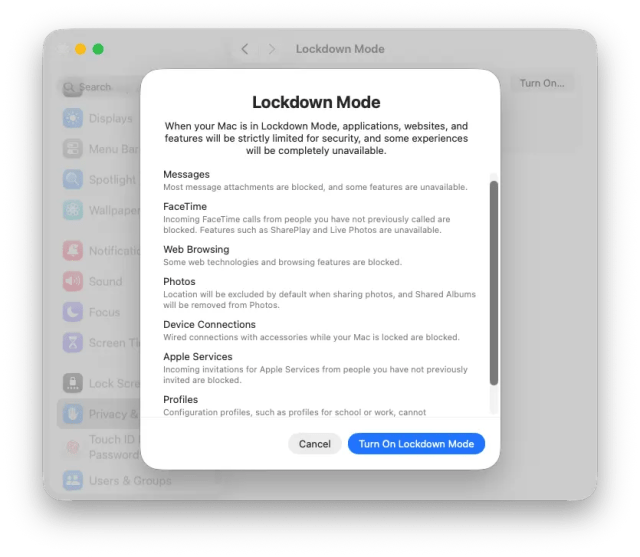
The trade-offs? It could actually break some options you depend on, like sure Continuity handoffs between units, some net apps, or incoming FaceTime calls from unknown folks. It is not meant for on a regular basis use; it is for when the danger is actual and well worth the inconvenience. For many of us, the on a regular basis habits and third-party safety are lots, but when your work places you within the crosshairs, this is among the strongest instruments Apple provides you.
Tip 10. Monitor Exercise Monitor for suspicious processes and test safety logs
Typically the primary clue that one thing’s off is true in your individual system instruments. Open Exercise Monitor (Highlight search: Command + Area, kind “Exercise Monitor”) and keep watch over the CPU, Reminiscence, and Community tabs. Search for unfamiliar processes utilizing unusually excessive CPU, spiking community visitors while you’re not doing something heavy, or processes with bizarre names that maintain respawning.

For a fast safety log test, open Terminal and run this command:
log present –predicate ‘subsystem == “com.apple.safety”‘ –last 1d –info –debug
(It reveals security-related logs from the final day; change “1d” to “7d” for per week.) Scan for something that mentions denied entry, unsigned code, or surprising privilege escalations. If one thing seems fishy, screenshot it and run a full scan with Moonlock or CleanMyMac straight away.
The best way to inform in case your Mac has a virus
Questioning in case your Mac is perhaps contaminated? I’ve realized to identify a number of telltale indicators that one thing’s not proper.
- Surprising advertisements and pop-ups: If advertisements seem the place they shouldn’t, even exterior your browser, you may need adware.
- Gradual efficiency: A sluggish Mac can typically imply malware is working within the background.
- Malware scanner alerts: If a safety app finds threats, take it significantly.
Should you do discover malware, again up your clear system with a software like Get Backup Professional, then restore if wanted.
Last ideas on protecting your Mac virus-free
Can Apple computer systems get viruses? Do you want antivirus on a Mac? I hope it’s clear by now — the reply to each is sure. Constructed-in macOS safety is powerful, however it’s not foolproof. For peace of thoughts, I like to recommend utilizing a trusted antivirus app and following the habits above.
All these instruments can be found by Setapp’s 7-day free trial. Should you’re like me and like having a curated toolkit slightly than looking down particular person apps, Setapp provides you entry to all these safety instruments plus 260+ different productiveness apps underneath one subscription.
Often requested questions
Do Macs have higher virus safety than Home windows?
Macs begin with stable safety: Apple controls the {hardware} and provides instruments like Gatekeeper, XProtect, and System Integrity Safety. As a result of Home windows PCs outnumber Macs, most malware nonetheless targets Home windows. That doesn’t make Macs immune. New Mac-specific threats seem yearly, so including a trusted third-party anti-malware (for instance, Moonlock and CleanMyMac) closes the gaps Apple hasn’t patched but. Backside line: Macs ship with good defenses, however no pc is hack-proof.
How do I do know if an antivirus app is already on my Mac?
Each Mac has built-in safety like XProtect and Gatekeeper. To test for added antivirus apps:
- Open Finder > Purposes and search for names like Moonlock, CleanMyMac, Malwarebytes, and so forth.
- Use Highlight (Cmd + Area) and seek for “antivirus.”
- In System Settings > Privateness & Safety > Profiles, test for any put in safety profiles.
Are Macs safer from hackers than different computer systems?
Macs are typically safer than many PCs as a result of Apple controls each {hardware} and software program. However no pc is immune. As Macs get extra widespread, hackers are concentrating on them extra usually. Good habits and up-to-date safety instruments are nonetheless important.
Do Macs have built-in antivirus, and is it sufficient?
Sure, macOS comes with XProtect (Apple’s built-in antivirus), Gatekeeper, and different security measures that block recognized threats. Nonetheless, these instruments solely defend in opposition to malware Apple already is aware of about. New or refined threats can nonetheless slip by. For full safety, it’s good to make use of a good third-party antivirus software program, like Moonlock or CleanMyMac, alongside macOS’s built-in defenses.
How can I inform if my Mac has a virus?
Search for these indicators:
- Uncommon pop-ups or advertisements, even while you’re not looking
- Your Mac feels sluggish or scorching for no motive
- Apps crash or behave surprisingly
- Safety instruments warn you about threats
Should you discover any of those, run a malware scan and take into account getting assist from an expert.
What on a regular basis habits maintain my Mac secure?
- Maintain your macOS and apps up to date
- Use sturdy, distinctive passwords (a password supervisor helps)
- Don’t click on suspicious hyperlinks or obtain unknown recordsdata
- Usually again up your information
- Use a VPN on public Wi-Fi
- Restrict app permissions in Privateness & Safety settings
