
- In 2026, there are six efficient monetisation fashions for impartial builders on Mac and iOS: subscriptions, the freemium mannequin, one-time purchases, distribution through Setapp, in-app purchases, and the hybrid mannequin.
- Subscription is the simplest mannequin for apps with long-term worth. One-time buy stays efficient for specialised utilities. Probably the most profitable apps mix two or three fashions.
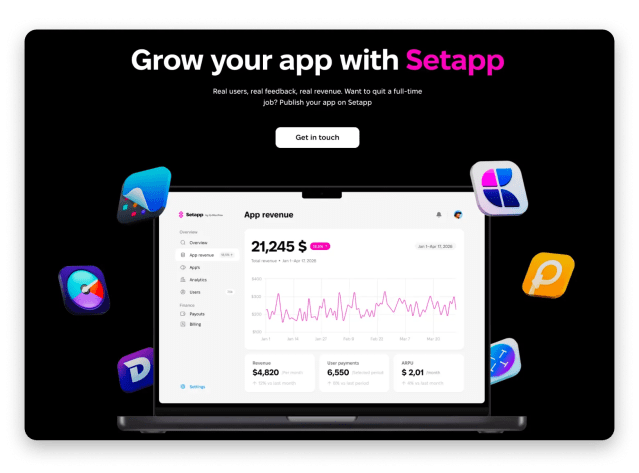
- Setapp distribution is the best manner so as to add a predictable income stream with out constructing your personal cost, tax, or discovery infrastructure. Develop into a Setapp companion.
Constructing a high-quality app for Mac or iOS in 2026 is the straightforward half. The onerous factor is determining easy methods to earn money from it.
Knowledge from Setapp’s personal analysis reveals a transparent pattern. Solely 34% of Mac customers rely solely on the Mac App Retailer. The remaining 66% obtain apps by builders’ web sites, app curation websites, and different channels, usually combining these strategies.
I requested impartial Mac builders what they really do to earn money. This information combines their solutions with Setapp’s personal analysis on Mac and iOS consumer behaviour.
7 app monetisation methods in contrast
First, let’s check out the totally different app monetisation fashions and the important thing info about each.
|
App monetisation mannequin |
Finest for |
Income predictability |
|
Subscription |
Apps with ongoing worth |
Excessive |
|
Freemium |
Extensive-reach apps with a transparent premium tier |
Medium |
|
One-time buy |
Centered utilities |
Low |
|
Setapp distribution |
Mac and iOS indie devs |
Excessive |
|
In-app purchases |
Apps with consumable add-ons |
Medium |
|
Hybrid mannequin |
Most apps in 2026 |
Excessive |
How does app monetisation work in 2026?
For Mac and iOS builders, income can come from direct funds (subscriptions, one-time purchases, in-app purchases), oblique funds (promoting, affiliate commissions, sponsorships), or by third-party platforms similar to Setapp, which deal with distribution and cost processing in trade for a share of the income.
Three shifts have reshaped the panorama in 2025-2026:
- Subscription progress retains accelerating. Weekly subscription plans now generate 56% of all app income, says Adapty’s State of in-app subscriptions 2026 report.
- Mac customers have moved past the Mac App Retailer. Setapp’s analysis on 700 US Mac customers discovered that 66% of Mac customers get some or all of their apps outdoors the Mac App Retailer. 76% of these customers flip to official developer web sites; 62% use curated app-collection websites.
- The Epic vs Apple ruling (Could 2025) opened exterior funds on iOS. US builders can now hyperlink to net checkout and bypass Apple’s 15-30% fee, paying a 3-6% cost processor payment as an alternative.
Now let’s take a look at every monetisation mannequin intimately, with actual numbers and founder voices.
Subscription mannequin
The subscription mannequin entails charging customers a recurring payment on a weekly, month-to-month, or annual foundation for ongoing entry to the app. In 2026, that is the dominant income mannequin for non-gaming apps.
The way it works for indie builders: You arrange paid entry (normally after a free trial interval), select a billing cycle, and use the App Retailer’s StoreKit or a third-party device to course of recurring funds.
Finest for: apps with ongoing worth, similar to productiveness, health, and content material apps, in addition to AI and mind-mapping instruments. In case your app affords one thing new each week, the variety of subscriptions will develop.
|
Professionals |
Cons |
|
|
Ulysses, a long-running writing app for Mac and iOS, follows an analogous subscription mannequin. It’s accessible immediately on the App Retailer or by Setapp Membership alongside 250+ different Mac and iOS apps beginning at $9.99 + tax per 30 days.

Freemium
The freemium mannequin gives customers with a free, absolutely useful model of the app after which sells entry to premium options by a one-time improve or subscription. That is how most “free” Mac and iOS apps that do not show advertisements earn money.
The way it works for indie builders: you present primary performance that solves the consumer’s drawback at a elementary stage, after which limit entry to superior options (export choices, AI instruments, cloud sync, themes, batch operations) by paid entry.
Apps like VSCO, Spotify, Duolingo, and Notion have constructed an enormous consumer base utilizing this mannequin, providing free entry and paid upgrades for superior options.

Finest for: Apps the place customers must really feel the worth earlier than paying. Picture editors, scanners, productiveness utilities, AI instruments, health apps.
|
Professionals |
Cons |
|
|
One-time buy
The one-time buy mannequin is what it seems like: customers pay as soon as and personal the app ceaselessly. It is more and more uncommon in 2026, however for the appropriate kind of app, it nonetheless works superbly.
The way it works for indie builders: you set the value (normally between $5 and $50 for utilities; skilled instruments value extra), and that’s the tip of the transaction. There are not any subscriptions, no in-app purchases, and no advertisements. After a one-time cost, you get lifetime entry and free updates inside a single main model.
Finest for: Centered utilities the place the worth is absolutely delivered at first launch. Calculators, file managers, textual content editors, code utilities, design instruments.
Soulver is an instance of a one-time buy app. You should buy it by itself, or get it as a part of Setapp Membership alongside 250+ different apps beginning at $9.99 + tax per 30 days.
|
Professionals |
Cons |
|
|
Setapp distribution
With Setapp, you’ll be able to listing your app on a curated platform that handles distribution, cost, tax compliance, and discovery in trade for a income share. It is a mannequin purpose-built for Mac and iOS indie builders who desire a predictable income stream with out constructing their very own infrastructure.
The way it works for indie devs: You submit your app to Setapp, move a high quality assessment, and begin incomes by one in every of two channels, or each.
Setapp Membership places your app in a curated subscription bundle that customers pay one month-to-month payment to entry, and your income is tied to precise consumer exercise.
Setapp Market lets customers purchase or subscribe to particular person apps separately, with every app priced individually by the developer. You retain your App Retailer itemizing operating in parallel, as no exclusivity is required.
Tip: A brand new app on Setapp sometimes will get ~30,000 distinctive impressions in its first days throughout 110+ nations.
“Setapp reveals what’s attainable when {the marketplace} cares about each builders and prospects. There is not any battle: everyone seems to be handled with dignity, and the expertise for me as a developer is a lot extra nice and constructive than with the App Retailer. The assessment course of on Setapp has at all times been fast, skilled and honest.”
— Zac Cohan, creator of Soulver.
“It has been nice. Manner higher than the Apple App Retailer. A lot sooner and clear opinions.”
— Sindre Sorhus, maker of Supercharge, Dato, Shortcutie, and Lungo.
|
Professionals |
Cons |
|
|
In-app purchases
In-app purchases (IAP) are particular person merchandise that customers purchase contained in the app. This app monetisation mannequin is usually utilized in video games, the place customers can buy further cash or credit. In photograph editors, IAPs would possibly embody further filter packs, whereas in AI apps, they could embody AI tokens, and so forth.
The way it works for indie devs: You outline merchandise in App Retailer Join, set costs, combine StoreKit, and customers purchase them by the usual Apple buy move.
Finest for: Apps with consumable assets (AI credit, scan packs), apps with elective characteristic packs, photograph editors with filter bundles, and apps that complement a subscription with one-shot purchases.
The favored sport Pokémon GO is an instance of an app with in-app purchases. Customers can play totally free, however for a extra immersive expertise, they will buy PokéCoins, Poké Balls, Stardust, and time-limited occasion bundles from a separate web page.

|
Professionals |
Cons |
|
|
Hybrid mannequin: the 2026 default
A hybrid mannequin combines two or extra income streams inside a single app. For instance, a freemium mannequin + subscription + in-app purchases, or App Retailer + cost through a web site, or a one-time buy + distribution by Setapp.
Finest for: Virtually all impartial Mac and iOS builders who’ve a completed app and a longtime consumer base. The hot button is to search out two or three sources which are a superb match in your app.
CleanMy®Cellphone is a superb instance of the hybrid mannequin in motion. It affords a month-to-month subscription, an annual subscription with a free trial, and a one-time lifetime buy. So customers can decide the mannequin that matches how they really use the app. It is also accessible by Setapp Membership alongside 250+ different Mac and iOS apps beginning at $9.99 + tax per 30 days.

|
Professionals |
Cons |
|
|
Remaining phrases: What’s one of the best app monetisation mannequin in 2026
The app’s monetisation mannequin is determined by its format. The most well-liked fashions as we speak embody subscription, freemium, one-time buy, Setapp distribution, in-app buy, and hybrid (a mixture of a number of of those).
For many Mac and iOS indie builders, the best and only hybrid mannequin is App Retailer distribution mixed with Setapp distribution as a second predictable income stream.
Publish your app on Setapp and achieve visibility and predictable income from day one!
FAQ
What’s the greatest app monetisation technique in 2026?
The perfect app monetisation technique in 2026 is to mix a number of income streams. In line with a Setapp research, 66% of Mac customers receive some or all of their apps outdoors the Mac App Retailer. Due to this fact, builders ought to think about internet hosting the app on a number of platforms.
